Is College Worth It in 2026? Real Costs, ROI and Alternatives Explained
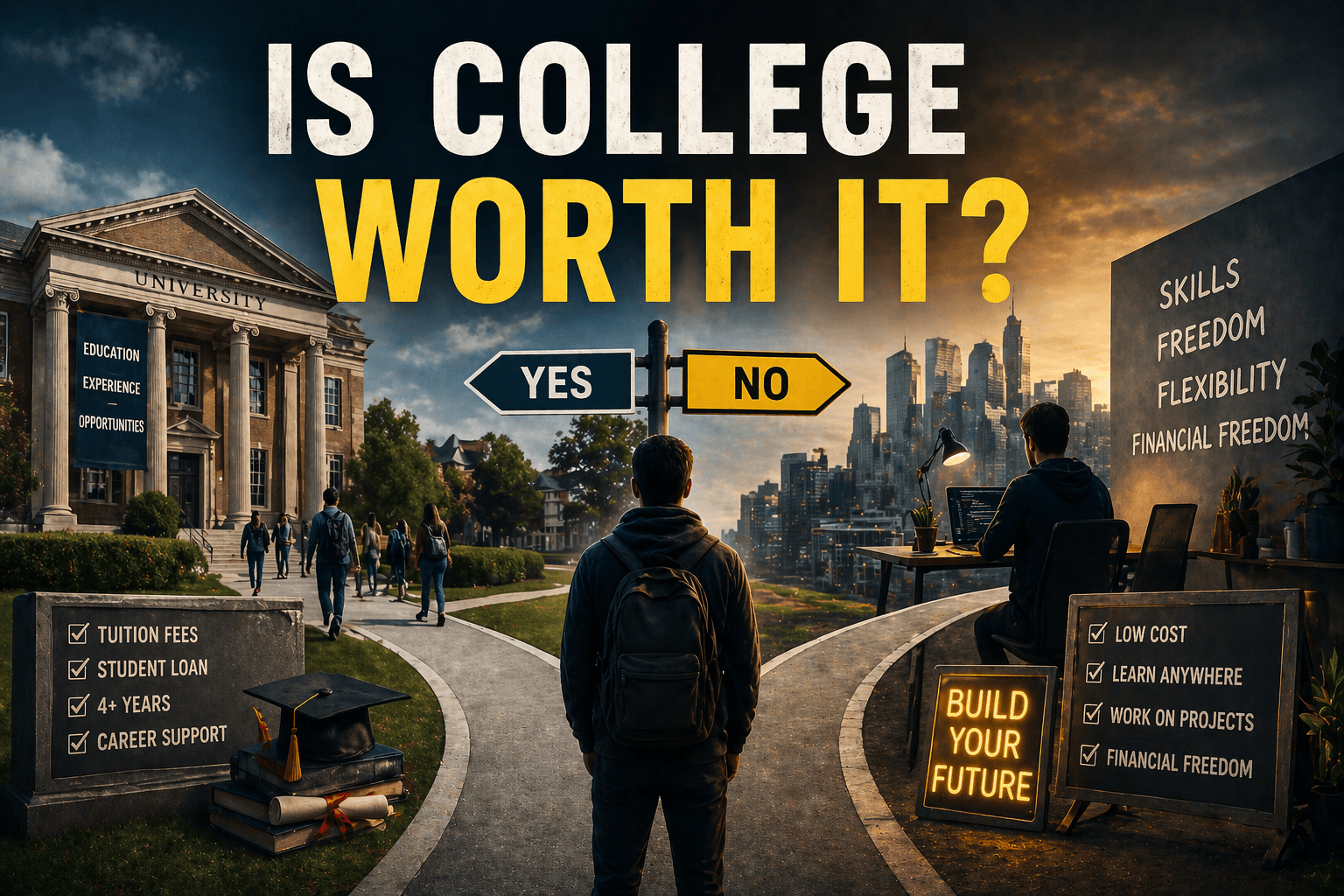
For decades, college was considered the safest path to a successful life. Graduate, get a degree, land a stable job. That formula worked for a long time.
But things have changed.
Tuition costs have increased significantly, industries are evolving faster than traditional education, and more people are questioning whether a degree still delivers the return it once promised. At the same time, alternative paths like online learning, freelancing, and entrepreneurship are becoming more accessible than ever.
So the question is no longer simple. It is not just “go to college or not.” It is about whether college still makes sense in today’s world.
The Real Cost of College
The biggest concern for most people is cost.
In many countries, especially the United States, a college degree can cost tens of thousands of dollars. When you include living expenses and lost income from not working full-time, the total investment becomes even higher.
This creates a financial risk. You are not just paying for education. You are betting that the degree will increase your earning potential enough to justify the cost.
For some careers, that bet still makes sense. For others, it does not.
When College Still Makes Sense
There are still clear situations where college is the right choice.
Fields like medicine, law, engineering, and certain scientific disciplines require formal education and certification. In these cases, a degree is not optional. It is the entry point.
College can also be valuable for people who benefit from structured learning environments, networking opportunities, and exposure to different ideas. For many, it is not just about the degree but about the environment and experience.
In these scenarios, college is less of a gamble and more of a necessary step.
When College Might Not Be Worth It
The equation changes in industries where skills matter more than credentials.
Technology, design, marketing, and many creative fields now value portfolios, real-world experience, and problem-solving ability over formal degrees. Employers increasingly care about what you can do, not just what you studied.
At the same time, the internet has made high-quality learning accessible at a fraction of the cost. Courses, communities, and real-world projects can often replace traditional education for motivated individuals.
If you are entering a field where outcomes matter more than qualifications, skipping college can sometimes be the faster and more efficient path.
The Rise of Alternative Paths
The biggest shift in recent years is not that college has become useless. It is that it is no longer the only option.
Today, you can:
- Learn skills online at your own pace
- Build a portfolio through real projects
- Start freelancing or working remotely
- Launch a business with minimal capital
These paths come with their own risks. They require discipline, self-direction, and the ability to navigate uncertainty. But they also remove the financial burden and allow faster entry into the workforce.
For some people, that trade-off is worth it.
The ROI Question
At its core, this decision comes down to return on investment.
If a degree leads to a career that significantly increases your earning potential, it can justify the cost. If it leads to debt without clear opportunity, it becomes a liability.
The problem is that this outcome varies widely depending on the field, the institution, and the individual.
There is no universal answer.
A More Honest Way to Think About It
Instead of asking “Is college worth it?” the better question is:
“Is college worth it for me?”
That depends on:
- What career you want
- How you learn best
- Your financial situation
- Your willingness to take risks
For some, college provides structure, credibility, and opportunity. For others, it slows them down and adds unnecessary cost.
The Decision Most People Avoid
What makes this question difficult is that both sides have strong arguments. College can open doors. But it can also create debt. Skipping college can accelerate your path. But it can also increase uncertainty.
That is why people keep debating it.